 "Originally it was a pastoral lease, 'Nairnup' itself, which went from where the fence used to be right to the coast. There was 250 000 acres in those days, north of the road. It joined the Moir's lease,
the Young River lease, so it was just a pastoral lease. Blake and Dunn operated it, they had the lease. They went along with their sheep and their cattle; they had sheep and cattle at the woolshed. There's one woolshed here ['Nairnup'], and one down on the coast, and they used to run most of the sheep on the coast with native shepherds.
This was just a home base for the horses and Blake and Dunn lived here. The Dunn boys never ever married, but Bob Blake he married Jane
Gibson that's how the early connection originally started. All that was developed here was about 500 acres that they used as their horse paddock and lamb paddocks, and that was completely dingo fenced with six foot fencing, the old fencing is still there, haven't touched any of that. My dad, as they got older, he used to spend more and more time here with them. Blake eventually left, he got out of it, and it was left to Bill Dunn. My dad made sure that he was OK. He used to
check on him every fortnight, or something, and when he came to Ravensthorpe he'd always stay with us. Dad eventually took over the lease from Bill Dunn; he originally had the lease to the whole
area.
"Originally it was a pastoral lease, 'Nairnup' itself, which went from where the fence used to be right to the coast. There was 250 000 acres in those days, north of the road. It joined the Moir's lease,
the Young River lease, so it was just a pastoral lease. Blake and Dunn operated it, they had the lease. They went along with their sheep and their cattle; they had sheep and cattle at the woolshed. There's one woolshed here ['Nairnup'], and one down on the coast, and they used to run most of the sheep on the coast with native shepherds.
This was just a home base for the horses and Blake and Dunn lived here. The Dunn boys never ever married, but Bob Blake he married Jane
Gibson that's how the early connection originally started. All that was developed here was about 500 acres that they used as their horse paddock and lamb paddocks, and that was completely dingo fenced with six foot fencing, the old fencing is still there, haven't touched any of that. My dad, as they got older, he used to spend more and more time here with them. Blake eventually left, he got out of it, and it was left to Bill Dunn. My dad made sure that he was OK. He used to
check on him every fortnight, or something, and when he came to Ravensthorpe he'd always stay with us. Dad eventually took over the lease from Bill Dunn; he originally had the lease to the whole
area.
[The bush down on the coast was] completely
different to what it is now. It was burnt,
continually burnt each year, sections of it. And it
was grass, and there were few places that you
couldn't drive sheep, or move sheep right through
that whole coast. There wasn't any mallee of any
consequence, it was just sort of edible shrubs.
The sheep did really well though.
It was completely different. There was no thick
scrub, there were little patches on the river and
in some of the swamps. All the cattle we found,
we built temporary yards there, we were driving
them from the coast through to here, we had
yards there, and we were trucking them out. But
you could see the cattle for miles away on the
coast, you could find them, and had no trouble
with them. They knew where the thick patches
of scrub were and once you got too close to them
they'd just disappear into them, you couldn't get
them out. But it was simple to muster stock, or
run stock on the coast. But areas were continually
burnt. I remember my Dad, if he was on the coast
he wouldn't go anywhere without he would drop
matches, wherever he thought to burn. It didn't
matter what time of year it was, the fires couldn't
go anywhere, it was always burnt next door. That
was how they controlled fires, and also how they
obtained their feed, the regeneration of the
natural scrub. There was no developed pastures
or anything it was just natural bush.
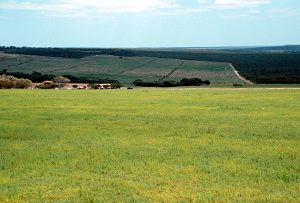 We didn't do anything with it. All we had was
the lease, and there was still cattle here on the
coast just running wild. We didn't do anything
with it until about 1956, or somewhere around
there. We just had a guy here looking after it,
just living in the old house. While having someone
here we didn't farm it or run any more stock or
anything on it until we came out in '66.
Yes it was virgin bush apart from that little section
there [inside the dingo fence]. Then what
happened was that in the sixties Esperance
boomed and the Chase crowd started and they
wanted more land. They approached us about
taking the lease back off us. At that stage we
weren't very concerned, we thought, "Oh well if
they want the lease they can have the lease".
But for them to take the lease all we said then
[was] that we wanted 10 000 acres of it here
and they can have the lease. That's exactly what
they did, they surveyed out 10 000 acres and
took the rest of the lease back, so that was how
we acquired it then. Well then that was
resurveyed and all the blocks out on the road
now they were all part of the lease. You can go
right down to the Fuss's, every block south of
the road used to be part of the lease. And some
north, but they never ever surveyed the complete
northern section. They just took out areas around
Munglinup and up through there. The rest just
became surveyed and was issued as CP
[Conditional Purchase] blocks".
We didn't do anything with it. All we had was
the lease, and there was still cattle here on the
coast just running wild. We didn't do anything
with it until about 1956, or somewhere around
there. We just had a guy here looking after it,
just living in the old house. While having someone
here we didn't farm it or run any more stock or
anything on it until we came out in '66.
Yes it was virgin bush apart from that little section
there [inside the dingo fence]. Then what
happened was that in the sixties Esperance
boomed and the Chase crowd started and they
wanted more land. They approached us about
taking the lease back off us. At that stage we
weren't very concerned, we thought, "Oh well if
they want the lease they can have the lease".
But for them to take the lease all we said then
[was] that we wanted 10 000 acres of it here
and they can have the lease. That's exactly what
they did, they surveyed out 10 000 acres and
took the rest of the lease back, so that was how
we acquired it then. Well then that was
resurveyed and all the blocks out on the road
now they were all part of the lease. You can go
right down to the Fuss's, every block south of
the road used to be part of the lease. And some
north, but they never ever surveyed the complete
northern section. They just took out areas around
Munglinup and up through there. The rest just
became surveyed and was issued as CP
[Conditional Purchase] blocks".
Ron Gibson