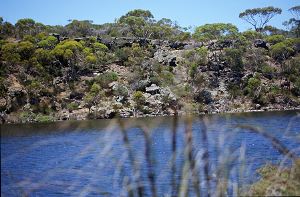
 "When we left Kenya we went down to see
Australia House [in Nairobi]. There they had a
big brochure on land available under Elders, the
Esperance Land Development as they were then.
They're Esperance Rural Properties now."
"When we left Kenya we went down to see
Australia House [in Nairobi]. There they had a
big brochure on land available under Elders, the
Esperance Land Development as they were then.
They're Esperance Rural Properties now."
Don MacKenzie
"[We saw the land advertised] in the "Weekly
Times", that's a Victorian paper, and it had a little
ad in it. But my husband [Bob] had already,
before I'd met him, [put in] applications."
Avril Lawrance
"Well during that time I took up a CP block, went
through the normal Land Court that was held at
the time, and I took that up in... 1959 I was
allocated the block I think. It was a Land Court.
The blocks were advertised, you applied for the
land through the Lands Department. There was
a court, an open court where you asked questions
if your submission had gone through. So we
actually had to sit in court and be sworn in. I
thought I had a very weak case actually because
I didn't have the finance to do all this, but the
fact that I'd been living there I think helped a
lot. My boss at the time, John Kelman, put a
reference in for me as well and I think that
probably helped. He guaranteed me a job during
the development phase. Anyway the block was
allocated. I don't think I was the worst applicant
(laughs), and they were probably looking for
anyone really who was prepared to take on the
land. I think it was seventy-five cents an acre
plus a survey fee and you had twenty years to
pay this off. So the actual cost of the land was
insignificant."
Peter Standish
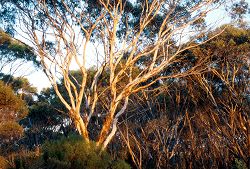 "Cheap land, that'd be the basics of it. Virtually
gave you the block. From memory it was seventy-
five cents an acre to buy it and that was an
interest-free loan, interest free for twenty years
anyway. If you cleared ten percent of it every
year until it was half cleared and boundary fenced
you could take freehold. We were told where
the boundary fence was and that was generally
around about five or ten chains off the river. No,
we just left it as it was and I suppose that's why
it's in such reasonable condition, because no one
was allowed to clear down to the river.
"Cheap land, that'd be the basics of it. Virtually
gave you the block. From memory it was seventy-
five cents an acre to buy it and that was an
interest-free loan, interest free for twenty years
anyway. If you cleared ten percent of it every
year until it was half cleared and boundary fenced
you could take freehold. We were told where
the boundary fence was and that was generally
around about five or ten chains off the river. No,
we just left it as it was and I suppose that's why
it's in such reasonable condition, because no one
was allowed to clear down to the river.
One of the areas I left on the two hundred acre
paddock, I left about ten percent in one very
sandy corner. When the inspector came down
just to make sure you were doing the right thing,
because conditional purchase you had to clear,
he found that that wasn't cleared and told me to
clear it and its blown away in the wind ever since.
Now it's growing pine trees."
Richard Field